
PRESS
What do Koreans do during Seollal?
- Post Date2022-01-31
설날 (Seollal) or Korean Lunar New Year is one of the biggest holidays in Korea. During this time, many Koreans visit their family, perform ancestral memorial service, eat foods, wear hanbok, and play folk games. Even though its vibe has been changed after the pandemic, still it’s the one of the most awaited days of the year.
Why do Koreans celebrate new year by Lunar calendar?
Until the mid-20th century, Korea was primarily an agricultural society, and the seasonal rhythms of daily life were organized by the lunar calendar. Because farming was hugely important for the subsistence of the members, such society developed a great variety of semi-religious events intended to pray for health, luck, good harvest, and abundant food. Those events gradually evolved into communal celebrations and festivals like Seollal.
What do Koreans do during Seollal?

▲ Charae
Copyright to Dailyan Reporter Park Hang-gu
If you like to watch K-Drama, I am pretty sure that you have seen them doing unique rituals on someone’s death anniversary. Truth is, Koreans perform several types of ancestral memorial services in a year to express gratitude to ancestors and remember them. 차례 (Charae) is one of them done on special occasions like Seollal. In the early morning of Seollal, all family members gather and do the relatively simple rituals to ancestors, wishing peace and prosperity for the year.
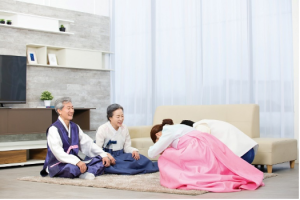
▲ Sebae
Copyright to KOREA.net
Also, younger people make a deep traditional bow to their elders wishing them a happy new year, which is called 세배 (sebae) or New Year’s bow. Then, the elders typically reward this gesture by giving New Year’s gift money to them (Usually, it’s only for children). When I was little, I remember I was bragging about how much money I was rewarded to my friends. If I get lucky, I was even able to receive the gift money from my parents’ friends who I ran into from their hometown. So, why not call it a most awaited holiday?

▲ Tteokguk
Copyright to Korean Food Promotion Institute
If there is one thing you shouldn’t miss during this holiday, it is the food. The most representative Seollal dish is 떡국 (tteokguk) or rice cake soup. The white soup and the white tteok or rice cake symbolize forgetting all the bad things from the previous year and starting afresh for the new year. Also, 가래떡 (garaetteok), general types of tteok used in the soup symbolizes long life due to its long shape. Believe it or not, few people still believe that we can grow one year older after consuming a bowl of tteokguk on the new year day.
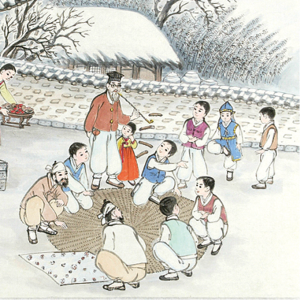
▲ Yutnori
Copyright to National Folk Museum of Korea
No matter how tired it is going to one’s own hometown and beating all the traffic, it’s worthy once we meet family, relatives and friends after a long time. We spend time saying hello and delivering blessing words for the new year. Also, folk games fill up the time that might be boring or awkward. One of the typical folk games played during Seollal is 윷놀이 (Yutnori). The word Yut translates to sticks and Nori means game. In Yutnori, four tokens are moved around a cloth game board. Instead of modern dice, 4 yut sticks, each having one flat side and one round side, are cast to control the movement of the tokens. Trust me, this is such a nice ice breaking game.
Seollal, Then and Now
As the country developed, the once agricultural society has transformed to an industrial society and it also changed the form of family from extended family to nuclear family. It also affects the way of spending the Seollal. Some no longer wear hanbok, some streamline the event or even spend the holidays abroad rather than seeing each other. Furthermore, 2 years of pandemic has been limiting the family gathering during the holidays.
Nevertheless, I believe that as long as the most important thing of this holiday doesn’t fade away, Seollal will stay longer with us. It’s the respect to ancestors and traditions.
In Japanese colonial period, Koreans were forced to celebrate solar new year’s day saying the lunar new year is the ‘old’ to belittle the Korean culture. Unfortunately, even after the colonial period, Korean government sticked to this system. However, people still recognized the lunar new year as the traditional new year’s day and visited their hometown on that day. Accordingly, in 1989, lunar new year’s day regained its name Seollal and the public holidays were also expanded to 3 days. (the day before, the day, and the day after)
Although how we spend Seollal has become different from back then, our willing to continue the tradition and to remember our ancestors remain the same as then like how Koreans try to keep traditions against Japanese colonial rule. And this will keep Seollal as one of the biggest Korean holidays in the future.

 Facebook
 X
X
 YouTube
 Instagram
 Blog
Blog
